

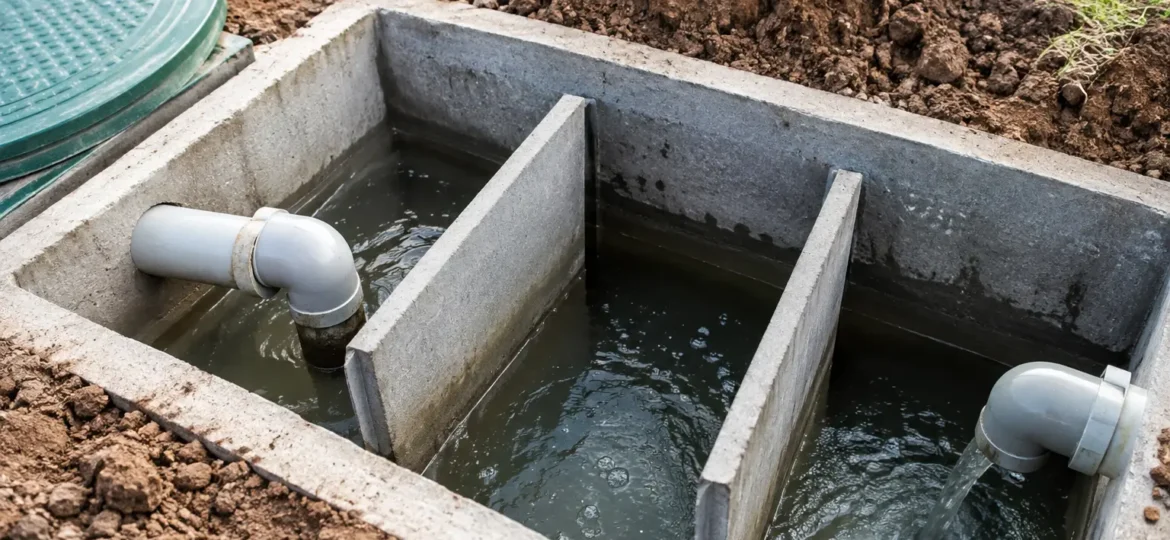
A septic tank can look fine from the outside while a failed baffle is quietly sending solids toward the drain field. That is a problem homeowners do not want to discover after sewage backs into a shower or wet spots appear in the yard. Septic tank baffles are small parts with a big job: they control how wastewater enters and leaves the tank so the system can separate solids the way it was designed to.
When a baffle breaks, falls apart, or becomes clogged, pumping alone may not solve the problem. The tank needs to be inspected, and the damaged component needs to be repaired before it turns into a drain field failure.
What septic tank baffles actually do
Most standard septic tanks have an inlet baffle and an outlet baffle. The inlet baffle directs wastewater from the house into the tank without disturbing the layers already inside. The outlet baffle keeps floating scum, grease, and solids inside the tank while allowing clarified liquid to move out to the drain field.
Inside a working tank, heavy solids settle to the bottom as sludge. Lighter material rises to the top and forms a scum layer. The middle liquid layer is the only part that should leave the tank. The outlet baffle acts as a barrier between that liquid and the material that needs to stay behind.
That barrier matters because a drain field is built to handle treated effluent, not toilet paper, sludge, grease, or floating debris. Once solids reach the drain field, they can clog the soil and pipes. Drain field repair is far more involved and expensive than replacing a baffle during routine septic service.
Why baffles fail
Older septic systems often have concrete baffles. Concrete is durable, but it is not permanent. Sewer gases inside the tank can corrode concrete over time, especially near the outlet. A deteriorated concrete baffle may crack, crumble, or collapse into the tank.
Many newer tanks use PVC sanitary tees instead. These are resistant to corrosion and usually easier to replace, but they can still come loose, crack, be installed at the wrong height, or become blocked by wipes and other non-flushable material.
Baffles can also fail because the tank has gone too long between pump-outs. When sludge and scum build up, there is less room for wastewater to separate. Material can press against or flow around the outlet baffle, putting the drain field at risk even if the baffle itself is still in place.
A good septic inspection checks more than the tank level. It looks at the inlet and outlet connections, the condition and depth of the baffles, signs of corrosion, the filter if the system has one, and whether solids are escaping where they should not.
Signs you may have a damaged septic tank baffle
A broken baffle does not always create an immediate backup. In many cases, the warning signs show up gradually as the system becomes less effective. Slow drains throughout the house, toilets that gurgle, and sewage odors near the tank or drain field are all worth taking seriously.
You may also notice that the septic tank needs pumping more often than expected, or that problems return shortly after it was pumped. If the outlet baffle is missing or damaged, solids may already be moving into the drain field. Pumping removes material from the tank, but it does not restore the barrier that protects the field.
Wet, spongy ground over the drain field is another red flag, particularly if the area smells like sewage or has unusually green grass. That does not automatically mean the baffle is the only issue. It could point to hydraulic overload, a blocked effluent filter, damaged field lines, or saturated soil. The right move is a professional evaluation, not guessing or adding septic additives.
Why a pump-out is the best time to inspect baffles
The best time to inspect septic tank baffles is when the tank is opened and pumped. With the tank empty or nearly empty, a technician can clearly see the inlet and outlet components and determine whether concrete is deteriorating or a PVC tee needs attention.
This is also when a septic company can measure sludge and scum levels accurately. A tank should generally be pumped before the combined sludge and scum layers take up too much of the working space. The exact schedule depends on tank size, household size, water use, garbage disposal use, and whether the property is residential or commercial.
For many households, pumping every three to five years is a practical starting point. A busy home with a smaller tank may need service sooner. Restaurants, offices, rental properties, and other commercial sites often need a maintenance schedule based on actual use rather than a general rule.
Do not assume a clean-looking access lid means the system is healthy. The critical parts are underground, and baffle damage can stay hidden until it affects the drain field.
Repairing or replacing a failed baffle
The repair approach depends on the tank material, the condition of the opening, and the type of baffle that failed. In many cases, a deteriorated concrete outlet baffle can be replaced with a properly sized PVC sanitary tee. This gives the tank a corrosion-resistant outlet barrier and can restore normal flow protection.
The job needs to be done correctly. The tee must be the right diameter and extend to the proper depth below the liquid level. If it is too short, floating scum can pass under or around it. If it is improperly secured or the outlet pipe is damaged, the repair may not hold up.
Some tanks have an effluent filter installed at the outlet. That filter catches smaller particles before they reach the drain field, adding another layer of protection. It needs regular cleaning as part of maintenance. A clogged filter can cause slow drains and backups, but removing it permanently is not a repair. It simply leaves the drain field less protected.
If the tank wall, outlet pipe, or surrounding soil has shifted, the work may go beyond a simple baffle replacement. A thorough inspection identifies whether there is a cracked tank, root intrusion, pipe damage, or a drain field issue that needs separate repair.
What not to do when you suspect a baffle problem
Do not pour chemical drain cleaners, fuel, bleach-heavy products, or miracle septic additives into the system hoping to fix the issue. These products cannot rebuild a broken baffle. Some can harm the beneficial bacteria in the tank or create a tougher, less safe pumping job.
Avoid flushing wipes, feminine hygiene products, paper towels, dental floss, cat litter, grease, or leftover food. Labels that say “flushable” do not mean the material belongs in a septic tank. These items can snag on baffles, clog filters, and add to the solids that threaten the drain field.
It is also smart to reduce water use until the system is checked if you have active slow drains, gurgling, sewage odor, or wet ground. Spread out laundry, fix leaking toilets, and do not send unnecessary water into a system that may already be struggling.
Protect the drain field before the problem spreads
The outlet baffle is one of the last defenses between your septic tank and the drain field. Replacing it early is straightforward compared with excavating and repairing a field damaged by years of solids carryover.
If you are due for septic pumping, ask for a complete tank inspection, including the inlet baffle, outlet baffle, and effluent filter. If you are already seeing warning signs, do not wait for a full backup. Chatta-Rooter Plumbing can inspect the system, explain what is wrong in plain language, and give you upfront options for the repair.
A septic system does not need fancy treatment to last. It needs the right parts in place, regular maintenance, and fast attention when something underground starts to fail.